Twenty Years of CRPD and National Sign Language

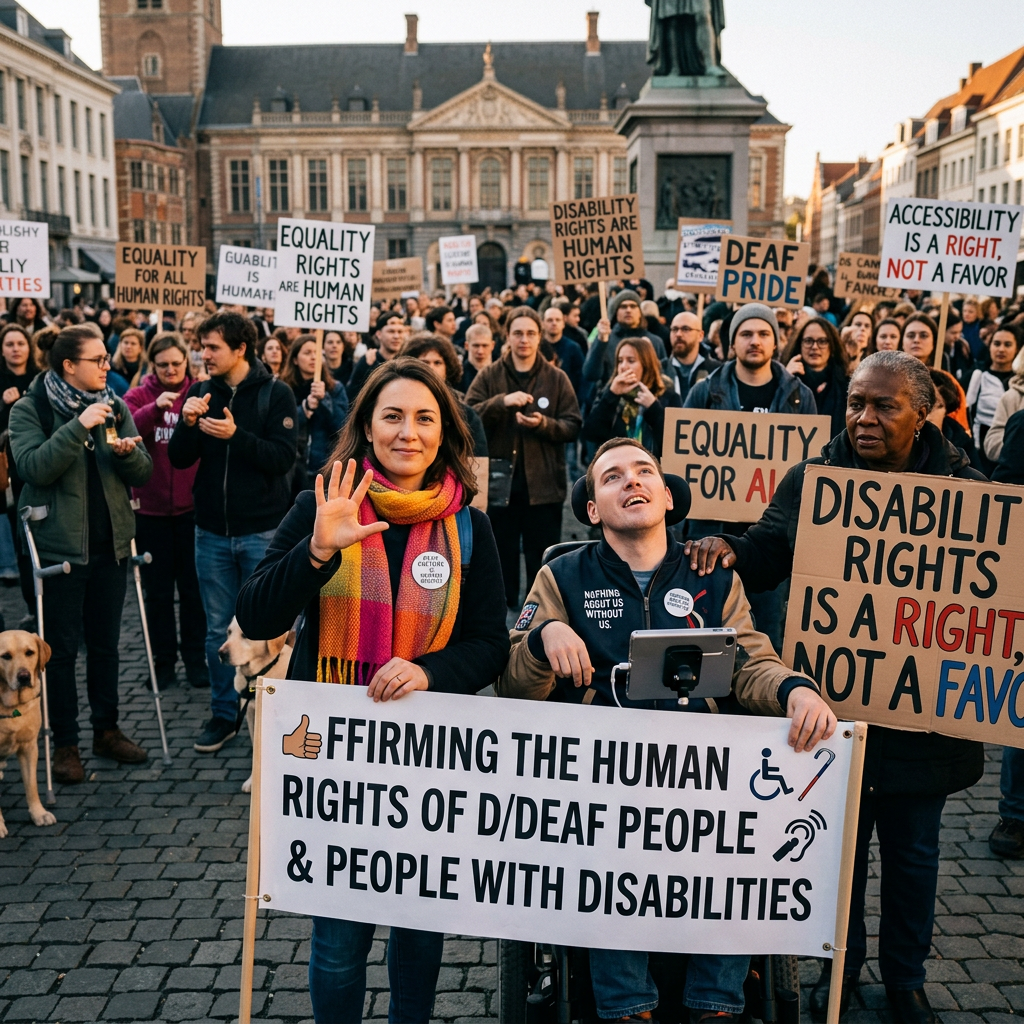
As we mark 20 years since the Convention on the Rights of Persons with Disabilities, we celebrate the recognition of national sign languages as full and equal languages. This recognition affirms the rights of D/deaf people and individuals with disabilities and reflects our commitment to their full realisation. My message is simple: sign languages are central to equality, inclusion, and access. I share this message as a member of the World Federation of the Deaf and as a deaf person with disabilities for over ten years.
In that spirit, my goal is to create engaging, accessible content that raises awareness of our language, culture, and community. This message supports equality and inclusion globally and is essential to improving accessibility and ensuring freedom for all. It reinforces the right of D/deaf people and people with disabilities to communicate fully and be recognised.

Reflecting on thousands of years of human history, D/deaf people have found ways to communicate, work in meaningful roles, participate in family life, and pursue diverse interests. This long history shows the depth, resilience, and value of Deaf communities, and supports the case for recognising their languages and rights.
Pre-Spoken Communication in Early Human Ancestors
Before the evolution of modern vocal tracts, early human ancestors relied on gestures, body language, and non-linguistic vocalisations. Some researchers suggest the earliest complex human language may have been a form of sign language.
The Core Pillars of Ancient Communication
- Gestural Communication: Hominins achieved bipedalism millions of years before their vocal tracts could produce speech. This freed their hands for complex hand signs, pointing, and body movements.
- Contextual Vocal Call Systems: Early ancestors used vocalisations—grunts, calls, and cries—conveying meaning through pitch, rhythm, and intensity to alert others to danger or coordinate actions.
- Onomatopoeic Imitation: Ancestors mimicked sounds from their environment to convey specific, context-heavy messages to their tribes.
- The Shared Brain Network: Modern brain imaging shows human speech and manual gestures are still processed in the same brain regions. This overlap reinforces the theory that our ancestors transitioned from hand gestures to mouth movements.
The History of Deaf Culture and Sign Language
Sign languages are natural, fully formed languages with distinct grammatical structures separate from spoken tongues. With that foundation, the history of the Deaf community shows a long struggle from survival and isolation to oppression, and finally to cultural recognition and rights. This history underscores why recognising sign language matters.
Ancient Eras: Coexistence and Marginalisation
- 360 B.C. (Ancient Greece) In 360 B.C., Socrates acknowledged the use of signs among the Deaf. Aristotle, by contrast, claimed that “men that are deaf are in all cases also dumb,” creating a lasting prejudice linking the inability to speak with an inability to reason.
- Roman Law: Under legal codes like the Justinian Code, individuals born deaf were denied fundamental rights. They could not sign wills, inherit property, or hold legal independence because they were presumed incapable of learning.
- Indigenous Sign Systems: Long before formal European education, complex sign networks existed globally. For centuries, Native American tribes used Plains Indian Sign Language for inter-tribal trade, diplomacy, and communication with deaf individuals.
The 16th to 18th Centuries: Formal Education and Standardisation
- The Renaissance Breakthrough: In the 1500s, Pedro Ponce de León taught deaf students to read, write, and speak using modified hand gestures, challenging the myth that deaf individuals could not learn.
- 1620 (The First Manual Alphabet): Juan Pablo Bonet published the world’s first formal book on deaf education in Spain, establishing a structured manual alphabet system.
- 1755 (The Birth of Public Schools): Charles Michel de l’Épée founded the first free public school for deaf students in Paris. By observing his students, he realised their existing home gestures were a genuine language. He compiled these into French Sign Language (FSL), proving that deaf individuals were fully capable of high-level intellect and reasoning.
│ EVOLUTION OF FORMAL EDUCATION │
│ 1500s (Spain) │ First private tutoring (de León) │
│ 1620 (Spain) │ First manual alphabet book (Bonet) │
│ 1755 (France) │ First free public school (l’Épée) │
│ 1817 (USA) │ First American school (Gallaudet) │
│ 1880 (Milan) │ The ban on Sign Language │
The 19th Century to Present: Resilience and Reclamation
- In 1817 (Transatlantic Expansion), Thomas Hopkins Gallaudet travelled from America to Europe to learn educational methods. He returned with Laurent Clerc, a deaf French professor, and together they established the American School for the Deaf in Connecticut. They blended French Sign Language with local American village dialects, giving rise to American Sign Language (ASL).
- 1880 (The Milan Conference Disaster): In a devastating blow to Deaf culture, the International Congress on Education of the Deaf in Milan voted to ban sign language in classrooms worldwide. They enforced “oralism”—forcing deaf children to rely strictly on speech and lip-reading. This pushed sign language underground for nearly a century and disrupted formal deaf literacy and community development.
- The 1960s–1970s Linguistic Renaissance: Linguistic research proved that sign languages possess their own rich grammar, syntax, and abstract properties like spoken tongues. This sparked a global movement in which Deaf communities reclaimed their languages as basic civil rights, strengthening the case for equal recognition.
- Building on that recognition, the human drive to sign is natural. In the 1980s, the Nicaraguan government brought isolated deaf children together for the first time. Without instruction, the children created their own sign language, complete with syntax and grammar, documenting the spontaneous birth of a brand-new language.
Leave a Reply